Artemis II: Optical and SAR images compared
Posted on 2026-04-02, by Racum.
Both my previous and current companies took satellite images from the Artemis II before its launch from the Kennedy Space Center on April 1st, 2026. Planet took an optical image, and ICEYE took a SAR (synthetic-aperture radar) image, and this is the perfect opportunity to compare both technologies.
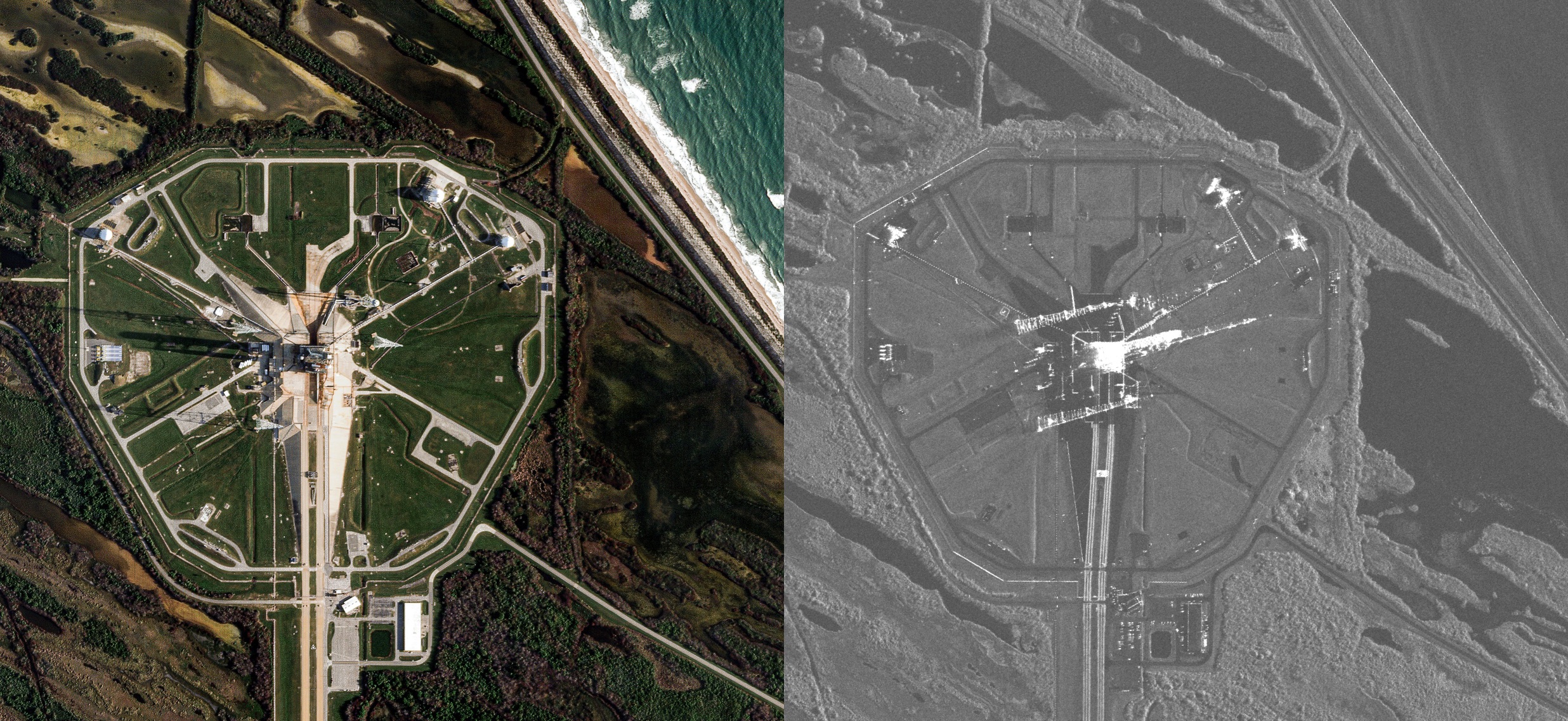
The SAR image is not just a grayscale version; it is actually a very advanced parsing of radar pulses, and the higher the radar energy reflected back to the satellite, the brighter the pixel becomes.
Things to notice:
- The launching tower and SLS rocket attached to it are the most bright objects in the image. That happens because their metallic structure reflects radar quite well. The same goes for the lightning towers and some sparse tanks around it.
- A good part of the space center is swampland. The darkest patches of the images come from the swamp-filled areas, with still water, that absorb radar the most.
- Notice that the sea area is not as dark as the swamp because of the waves, that tend to reflect back a small (but detectable) amount of radar energy.
- Other than that, we can see a gradient of reflectances based on various materials, enough to be noticeable, like: wild vegetation, grass, concrete tracks, etc.
Also, the launch happened during a clear day. If it was a night launch, the optical image would be mostly black; or, if it was during a cloudy day, we would see mostly white; meanwhile, the SAR image would be unaffected by any of those scenarios, always resolving a good image.